

Coming to South Korea is a decision that’s becoming increasingly popular among recent and former college graduates who want to do one of two things: make money, and make a difference. Bear in mind you will be doing more of the latter, but the lifestyle is still very comfortable and enriching. The US president is negotiating peace agreements with North Korea’s Kim Jong Un, and rumor has it the current South Korean President’s ancestry is from there; a traditional homage to his familial history may be the sentiment that ameliorates tensions between North and South. Coincidentally, as I’m writing this, South Korean president Moon-Jae In is visiting North Korea to attempt a peace agreement between the two countries. We’ll see what transpires.
But here I am, in my studio apartment writing about politics, when I’m here to teach English to elementary and middle school children; time to buy some chocolate and candy. The Korean culture considers each human being to be the age of 2 after birth, which automatically puts them two years ahead of everybody else in school. This has long-term benefits, but the stress that kids face while pushed to succeed is debilitating not only to them, but to English teachers as well.
From a young age, learning English is considered a basic necessity if you want to reach your full potential, especially in Asia. This has been an existing standard for over 40 years, but has become more and more emphasized. English opens the door for increased trade, industry and smoother cross-cultural business transactions; an asset to any foreign country, especially one with as much technological clout as Korea.
The benefits of working in Korea are many, but above all else, you’ll be invited into a dynamically competitive society that is quite technologically advanced. If you choose to work in a private school versus a public school, you will also become part of the private school’s family. Most private schools are actually run by families and you are their shining bright new star when you arrive so be prepared to act like a professional citizen and remember to represent your English-speaking country with dignity and good-judgement.
Quite a few similarities exist between all the Asian countries, but there are differences as well. Similarities include street vendor food, bowing of the head, densely packed cities and motorcycles as a common mode of transportation for the city-worker. The main difference between all the countries is primarily the food. Although it is true that most southeast Asian countries have one form of curry or another, with rice being a staple choice of carbs with which to enjoy your entree, the primary spices and vegetables used in soups and salads vary widely. Rolls and fried dishes are also quite prominent the further North and Northeast you travel (Korea/Japan).
Before I get into the details of Pan-Asian cuisine, lets dive into the necessary items you will need for teaching in Korea:
1.) A passport. You will need this to apply, submit an application for a Work Visa, obtain your ARC (Alien Registration Card), and depending on which banking system you choose, even setting up a bank account.
2.) Copies of college degrees and/or transcripts. Be prepared for the somewhat lengthy process of Apostilling your college diplomas. You will be asked to have two copies of the original diploma Notarized at the local UPS store or other notary public facility, then send them to D.C. to have them Apostilled. This is required by the Hague Convention and officially states that your education was legal and certified by a recognized educational institution. If I were putting my children in the hands of a foreign national, I would want them checked out too. With that logic in mind, it makes sense and you just have to do it.
3.) FBI Criminal Background Check. This part of the application requires a licensed finger printer to take your finger prints on a state-issued fingerprint sheet, send it in along with the apostilled diplomas that have been mailed back to you (and hopefully approved) from D.C., to the US Authentication Services. This process along with the degree apostilling takes approximately 2-3 months so plan accordingly. More helpful information on this can all be found online. Here’s a website to get started: Document information
4.) VISA. A work VISA will be required to work in any country. The process is similar for Japan, South Korea, Thailand and China and I’m sure they’re not too different for other countries around the world. This is the last step before the school officially expects you to arrive. After all the degrees, FBI criminal background check and official resume/letters of recommendation have been sent to the school, they will start the process of acquiring a VISA issuance number for you specifically. When received, simply take this number to the local Korean Consulate or Embassy and start the paperwork for a foreign work visa.
5.) Passport photos. Be prepared to take a lot of passport photos. From the work visa, to the school’s health documents, to the ARC card, you’ll need at least 6.
6.) Finances. Make sure you’re finances are in check. Some people work in Korea to pay off student loan debt, because the apartment costs are covered and for the most part, you make money. I worked here to see if I really want to become an educator as a career, but making money is definitely an added bonus. It would be wise to pick up at least $100 USD (and any relative currency amount if you’re from Canada, UK, Australia or South Africa), before getting on that final plane headed to Seoul/Incheon or Busan/Gimhae International airports. Before leaving your hometown/country, ensure you have access to at least $800 USD of cash to convert into Korean Won. The first month will dig into your wallet a bit, including a $100 mandatory Korean issued physical exam conducted by the Korean healthcare system. An additional $30 will be needed for the cost of your ARC ID card. The rest is for spending on groceries and travel expenses. The first payment for your employment will be made approximately 5 weeks after you land.
7.) Cell Phone. Make sure your cell phone plan facilitates your freedom to travel. High roaming charges eliminate the practicality of using apps linked to the GPS system, so two options are at your disposal if you have a smartphone:
* Obtain a SIM card at a Korean cell phone company (Olleh, SKT or LG), and sign up for a data plan. This allows you to connect your current phone number back home to the Korean number so any incoming calls from out of the country will be free from any charge.
* You can also get a wifi egg, but it MUST be part of the cheapest data plan (ie: 10-15K WON/month) if you want to make it work. The only other wifi egg option is for travelers who are in Korea for a limited amount of time, and want access to personal wifi while traveling for 1 to 2 weeks. For them, a wifi egg costs approximately 4,000 won per day. You can see why this won’t work for people who plan on teaching for the duration of a whole year.
* The third option is to have both a foreign phone plan and a Korean phone plan, but unless the phone is issued by the employer there’s no practical reason why two phones is necessary.
8.) Toiletries. Be sure to pack lotions, shampoos, soaps and vitamins that are part of your daily health routine. South Korea has very good substitutes, but the consistency of their products is different from what one may be used to in the United States or elsewhere. Furthermore, imported products are quite expensive due to most taxes being included in the sale price of the items you buy. A regular bottle of Lubriderm lotion would be approximately $8-$11 in the US, but in South Korea it is well above 17,000 WON (around $15). Lastly, bring at least 3 large towels from home and pack LIGHT. The towels here are super small. Chances are also slim to none that you’ll have a drier at the apartment so get comfortable with hang-drying. It’s no sweat, just iron out the creases if you’re particular with clothing. Lastly, deodorant is scarce, so if you’ve developed an affinity for Old Spice or Axe, bring them.
Once stepping foot in Korea, there are several noteworthy items to go over that will help you transition smoothly into Korean life.
1.) Transportation.
Cost effective modes of transportation. Korea is incredibly easy to navigate, thanks in large part to the numerous transportation options available. Aside from owning your own car (which can be done, but forget about saving money). Here are the main ones in descending order, from least pricey to most pricey.
* Bicycle: Rent shops are everywhere, and buying a bicycle first or second hand would be a good ideas for those looking to get some exercise while commuting to and from work.
*Buses: Korea has bus terminals in every city, and these buses travel throughout the country. Local bus lines are good ways to go to your local Lotte Marte or Home Plus for groceries, but if you’re looking to get your moneys worth for a weekend trip, buses are the way to go. The only downside is they take longer to arrive at your destination. Going from Incheon Int. Airport to Geoje Island costs $42 and takes approximately 6 hours.

*SUBWAY: Once in a city such as Daegu, Wonju, or Ulsan, there’s a massive Subway system that rivals the one in New York and London. It’s incredibly fast and easy and takes you across the entire city (approximately 20 stops in 1 hour) for about the equivalent of $2 USD.


*KTX: The bullet train system provides quick and easy transport to and from major cities. For example, going from Busan to Seoul costs $51, and takes approximately 4.5 hours.
*Taxis: These are the most costly, albeit still quite a bit better than US taxis. Unless you’re in Seoul or Busan, there aren’t too many Ubers driving around and if pressed for time, Taxis are your only option. A 5.4 mile trip (8.7 KM) cost me around 19,000 WON, or around $17 USD. For most, this is still quite a bargain considering the fact that it’s an independent franchises.
Taxis can be flagged down on any street. The more rural areas won’t have one unless you’re lucky and you will need to take a bus deeper into the city so plan accordingly. An available taxi has a red light on top or on the inside, passenger windshield. Most will know the location of your destination, but the best way to guarantee a timely arrival is to show a screenshot of your current location and the location you need to get to on a GPS map. Then zoom in and identify the exact address. They will type it into their GPS device and then take you there. Once in a great while, you will be refused service. This isn’t because you smell bad or don’t speak Korean, but because the taxi driver is heading in the other direction; possibly going home or ending their shift. Don’t take it personally. Just enjoy the ride, and don’t feel the need to tip…it’s not customary in Korea.
2.) Food
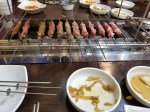
If your palate has been conditioned to enjoy fresh salads, organic tofu, and tempeh, then it might take some research to find what you need in Korea. Produce, and imported goods are generally 25% pricier than in the U.S., and Korea is big on meat, so vegetarian foods are hard, but not impossible to find. I say this, because Korean food is very pasty, and oily and whether it’s Shabu Shabu, Kimchi or soup, there’s a spicy paste that is used which I’m not particularly a fan of. What’s amazing is the fact that Koreans are cognizant of this, and make other menu items available. However, if you’re trying to eat and save, here are some Korean dishes that should both satisfy you, and keep you well nourished:
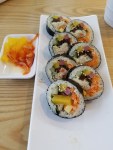
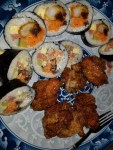

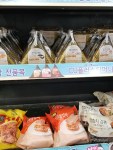
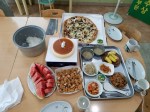

- Kimbap. Unless you have an aversion to seaweed wraps, this is an all in one filler. It includes rice, a choice of meet (beef, chicken or fish), pickled radish, and usually cucumber and carrot slices, with a piece of egg thrown in. I personally love it and it is a quick, easy way to eat lunch and have your appetite satiated. (take a picture of Kimpab and insert here). What separates this from the Japanese sushi version is the sesame oil used in Kimbap rather than the vinegar in the Japanese version. There are also more pickled vegetables in Kimbap. At the local GS25 or 7 eleven stores, you can also pick up a quick triangle version on the go, but these usually just have meet and mayo.
- Soups here exist in two main variants. The first is a brothy, salty Ramen noodle soup with vegetables and your choice of meat. The other is a rice porridge called Jook. Other soups will have to be homemade or bought at a non-Korean restaurant.
Korea has few alternatives for Asian cuisine. Shabu Shabu and Bibimbap are tasty and nutritious in their own right, but if your palate is used to the spices of Thai food and Chinese food, bring your own recipes and make them at home. I make a bi-weekly trip to the local food mart, and buy chicken, tofu, eggs, and a fresh batch of vegetables and fruit to last 2 weeks. This is a comfortable way to live that leaves room for weekly restaurant outings. Food here is not inexpensive, but with the right mindset, it’s “nattaproblem.”
There’s an extremely rewarding experience to look forward to at the end of this application process. Teaching abroad is fun, enriching and a great stepping stone into adulthood. Acquiring new friends and traditional concepts will enhance any existing resume, and give anybody a wider scope of the world. Feel free to reach out to me with any additional questions. I hope this was useful.
Ciao,
Nattaproblem
Nattapon Jontom Abbett
 Nattaproblem
Leave a comment